Know What The Reviewer Wants Before You Draw.
Bedrock is the AHJ and utility database behind every EnergyScape plan set, permit, and interconnection. 15,000+ AHJs and 1,000+ utilities, in one place inside Dataverse.
Code editions, local amendments, setbacks, submission rules, and the rejections each reviewer has actually issued. Looked up once, not researched per job.
Code books don't reject permits. Reviewers do.
Public code trackers tell you which NEC edition a state adopted. They don't tell you what the plans examiner in that county sent back last month. Bedrock is built from the files our team submits every day, so it records both.
Built from real submissions
Every record is verified against permits, stamps, and interconnection filings our team has actually put through that jurisdiction and utility.
Rejections feed the record
When a reviewer or utility sends a redline, it goes into Bedrock. The next set for that jurisdiction is built knowing what gets rejected there.
One source, every team
Drafters, PE reviewers, permit coordinators, and Greenlight QC all read the same record. Nobody works from an old spreadsheet.
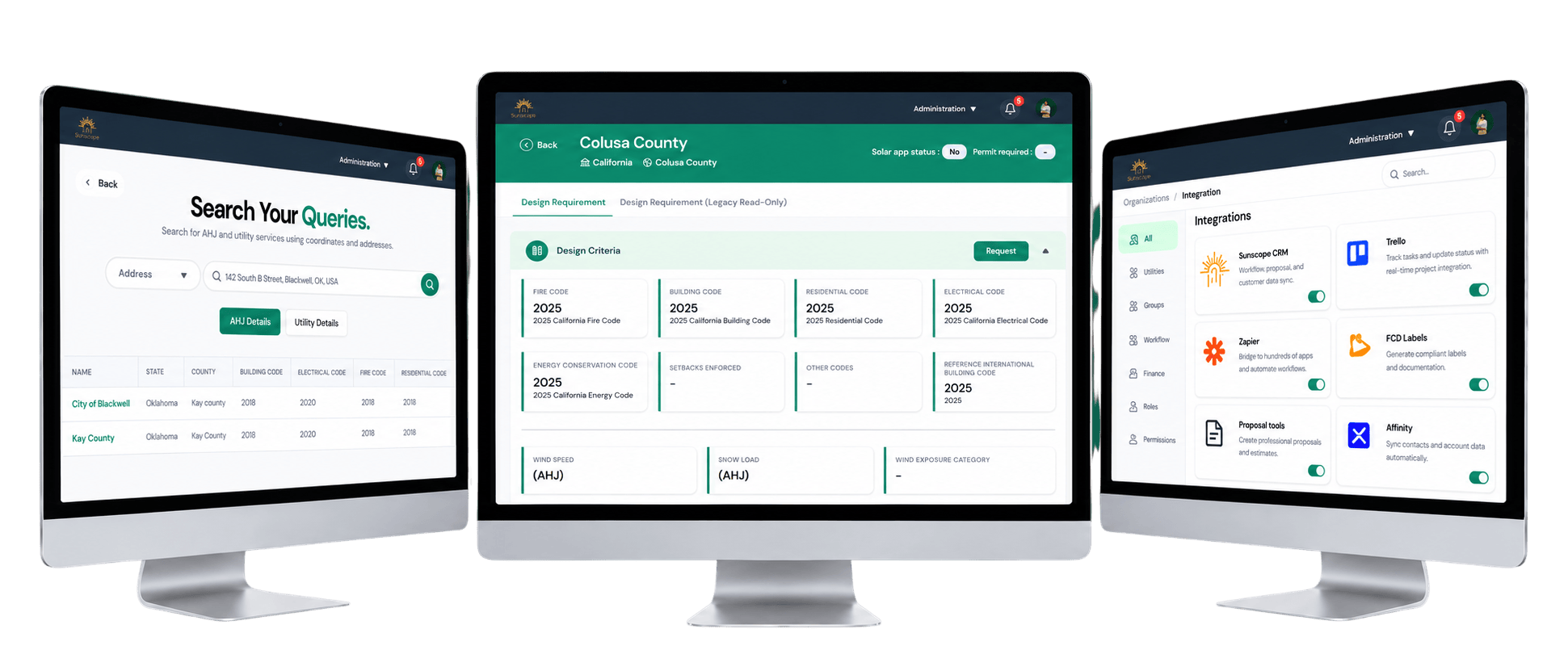
What every record holds.
Code editions in force
NEC, IRC, IBC, and IFC editions the jurisdiction actually enforces, not just what the state adopted.
Local amendments
County and city changes to the base code, captured where they differ from the state.

Setbacks and fire access
Ridge, hip, valley, and edge pathways, plus ground-mount and equipment clearances.
Structural criteria
Wind speed, snow load, exposure, and the ASCE 7 edition referenced for that jurisdiction.
Submission rules
Portal, SolarAPP+, email, or counter. Fees, required attachments, sheet order, and format.
Stamp and placard requirements
When a PE seal is required and which labels and placards the inspector expects to see.
Interconnection thresholds
System size tiers, study triggers, and which application path a project falls into.
Application requirements
Forms, one-line diagram format, equipment specs, and supporting documents each utility asks for.

Service and metering rules
Supply-side and load-side connection rules, meter requirements, and disconnect placement.
Storage and export limits
Battery, export limiting, and non-export requirements where the utility sets its own terms.
PTO documentation
What the utility needs after inspection before Permission to Operate is issued.
Rejection history
Every redline and kickback we have handled, tagged to the reviewer or utility that issued it.
How a record stays current.
Researched at source, verified on submission, corrected on rejection.
Researched
Code editions, amendments, and submission rules gathered from the jurisdiction and utility directly.
Verified
Confirmed against real filings our permitting and interconnection teams have put through.
Used
Drafters, PE reviewers, and Greenlight QC read the record on every project in that jurisdiction.
Corrected
Redlines and utility kickbacks are logged against the AHJ or utility that issued them.
Reviewed
Records are rechecked when codes change or a new edition is adopted.
Bedrock sits under everything we deliver.
You may already be using it. Every EnergyScape service and every Sunscape project reads from the same database.
Plan sets & Greenlight
Before the set leaves
Every plan set is drafted to the jurisdiction's record, then checked by Greenlight QC against its codes, amendments, and past rejections before delivery. 99% clear on the first pass.
See plan setsPermitting & PTO
When the package is filed
Permits and interconnection applications are packaged to the format and attachments each authority and utility expects.
See permittingSunscape
Where the job is tracked
Integrated AHJ puts the jurisdiction and utility record directly on each Sunscape project.
Explore SunscapeResearching per job versus looking it up.
Every bounced set makes the next one stronger.
A correction comes back from a plans examiner. Our team resolves it, then records what was asked and why. From that moment, every drafter and every Greenlight QC run for that jurisdiction checks for it.
- Redlines tagged to the AHJ, reviewer, and sheet
- Utility kickbacks tagged to the application type
- Greenlight QC checks known rejections before delivery
- The fix is applied upstream, not job by job
-
Redline received
Received -
Correction resolved
Resolved -
Logged to the record
Recorded -
Added to Greenlight checks
Active -
Next set for this AHJ
Pre-checked
Build on what the reviewer already told us.
Bedrock isn't sold on its own. It comes with every project you run through EnergyScape Renewables. Send your markets and volume, and we'll show you how your jurisdictions and utilities are covered.
Frequently asked questions
Still have a question?
Can't find the answer you're looking for? Send us an email and we'll get back to you as soon as possible.
Contact usThe AHJ and utility database inside Dataverse, our data platform. It holds the code, submission, and interconnection requirements for 15,000+ AHJs and 1,000+ utilities, plus the rejection history behind them.
Trackers report what a state adopted. Bedrock records what each jurisdiction enforces and what its reviewers have rejected, verified against filings our team has actually submitted.
Records are verified every time our team files in that jurisdiction or with that utility, and updated whenever a rejection comes back. They are also rechecked when codes change or a new edition is adopted.
If you use our plan sets, PE stamping, permitting, or interconnection services, yes. Every one of them is built and checked against Bedrock. Sunscape's Integrated AHJ reads from it too.
Yes. 1,000+ utilities, with interconnection thresholds, application requirements, metering rules, and PTO documentation.
Greenlight, our AI QC tool, checks every set against the Bedrock record for that jurisdiction, including its known rejections, before a human reviewer signs off.
Send your markets through the form and we will walk through coverage and access options for your team.